

Most customers check Google before they buy a product, book a service or contact a business. If your website doesn't show up for those searches, a competitor's does. That is the problem SEO solves.
This guide explains what SEO is, how it works, the types of SEO services, the process, what SEO costs in India and how long it takes to show results. It is written for business owners, so you know what to ask before you hire anyone.
Key takeaways
SEO means search engine optimization: improving a website so it ranks higher in unpaid search results.
SEO works in three stages: crawling, indexing and ranking.
The main types of SEO are on-page, off-page, technical and local SEO.
Most websites see early results in 3 to 6 months and stronger gains in 6 to 12 months.
SEO services are priced as monthly packages, one-time projects or hourly consulting.
What Is SEO? Meaning of SEO in Simple Words
SEO stands for search engine optimization. It is the practice of improving a website so it appears higher in the unpaid results of search engines like Google. The goal of SEO is to bring in visitors who are already searching for what you sell, without paying for each click.
In simple words, SEO helps the right people find your website at the moment they need you. A bakery in Chandigarh wants to appear when someone searches "birthday cake near me". An online store wants to appear for "buy cotton kurtas online". SEO is the work that makes that happen.
Paid advertising charges you for every click. With SEO you don't pay per click, which is why organic search is one of the most cost-effective marketing channels over time. BrightEdge research found that organic search drives 53% of all trackable website traffic.
How Does SEO Work? Crawling, Indexing and Ranking
SEO works by helping search engines find your pages, understand them and judge them as the best answer to a search. Every page goes through three stages before it appears in results:
Crawling. Google's bots follow links to discover your pages. Pages with no internal links pointing to them are often missed.
Indexing. Google analyses each page's content and decides whether to store it in its index.
Ranking. When someone searches, Google compares the indexed pages and orders them by relevance, quality and trust.
For SEO to work, search engines must be able to reach your pages, and your content must match what people search for. Credible backlinks and a good user experience then push your rankings higher. Google explains the basics in its SEO Starter Guide.
What Is the Difference Between SEO and SEM?
SEO earns unpaid traffic from organic search results. SEM, or search engine marketing, usually refers to paid search ads such as Google Ads. SEO takes longer but keeps working without ad spend; SEM brings visitors immediately but stops when the budget stops.
What Are the Types of SEO Services?
There are six main types of SEO services: on-page SEO, off-page SEO, technical SEO, local SEO, ecommerce SEO and international SEO. Each one covers a different part of your website's visibility, so knowing what each does helps you see where your site needs work.
Type of SEO | What it covers | Who needs it most |
On-page SEO | Content, title tags, headings, meta descriptions, internal links | Every website |
Off-page SEO | Backlinks, brand mentions, reviews, digital PR | Sites building authority and trust |
Technical SEO | Site speed, Core Web Vitals, crawlability, schema markup, mobile usability | Large, older or complex sites |
Local SEO | Google Business Profile, local citations, "near me" searches | Shops, clinics, service-area businesses |
Ecommerce SEO | Product and category pages, filters, product schema | Online stores |
International SEO | Hreflang tags, country and language targeting | Brands selling across borders |
The SEO Process: How SEO Is Done Step by Step
The SEO process has six steps: keyword research, competitor analysis, an SEO audit, content optimization, link building and performance tracking. A good SEO strategy moves from research to action to measurement, then repeats every month.
Keyword research. Find the terms buyers actually type, weighing search volume, difficulty and intent.
Competitor analysis. See who ranks today, what they cover and where they fall short.
SEO audit. Uncover broken links, slow pages, duplicate content and indexing errors.
Content optimization. Improve existing pages and create new ones that answer search intent better than what is on page one.
Link building. Earn relevant backlinks from trusted sites in your industry.
Performance tracking. Monitor rankings, organic traffic and conversions, then refine.
Skip keyword research and you risk ranking for terms nobody searches.
SEO Strategies That Grow Organic Traffic
The SEO strategies that last share one principle: put the searcher first. Four strategies do most of the work for a growing website.
Keyword targeting by intent. Match informational keywords to guides, commercial keywords to comparison pages and transactional keywords to service pages. One page, one main intent.
Topic clusters. Build a pillar page on a broad subject and link it to focused articles. This shows search engines your site covers the topic in depth.
Content refreshes. A page ranking on Google's second page can often move up faster with stronger headings, clearer answers and better internal links than a newly published post.
Backlink strategy. Choose relevance over volume. One link from a respected industry publication outweighs dozens from unrelated directories.
Together, these build consistent organic traffic growth instead of temporary spikes.
What Are the Benefits of SEO for a Business?
The main benefits of SEO are higher Google rankings, more website visibility, steady organic traffic, better-quality leads and more conversions. Unlike ads, these benefits grow the longer you invest.
Higher Google rankings for the searches that lead to sales
More visibility while customers compare their options
Steady organic visits that don't stop when your ad budget does
Better-quality leads from people already looking for what you offer
More conversions from faster, clearer pages
SEO vs Google Ads: Which Is Better for Your Business?
Google Ads is better for quick results, and SEO is better for long-term growth. Paid ads stop bringing in visitors the day you stop paying. SEO takes longer to build, but the traffic keeps coming after the work is done.
Many businesses run both: ads for quick leads while SEO builds a steady base. SEO is one channel among several, and our guide to digital marketing services explains how they work together.
How Much Do SEO Services Cost in India?
SEO services in India typically cost [INR X to INR Y] per month for a small business and [INR X to INR Y] for a competitive or national campaign. There is no universal price: cost depends on what your site needs and how competitive your market is.
SEO companies usually charge in one of three ways:
Pricing model | What you pay for | Best for | Typical cost in India |
Monthly SEO packages | Retainer for ongoing optimization, content and link building | Businesses wanting steady growth | [INR X to Y per month] |
One-time SEO projects | Fixed fee for an audit, site migration or technical clean-up | Sites with a specific problem | [INR X to Y per project] |
Hourly SEO consulting | Expert advice; your team does the work | In-house marketing teams | [INR X to Y per hour] |
What Affects SEO Pricing?
Five factors decide the price of an SEO package: the size of your site, keyword competition, the number of locations or countries, how much content is needed each month, and the site's current technical health.
Be careful with extremely cheap SEO packages. They often rely on poor-quality backlinks that can damage your rankings.
SEO Agency, Freelancer or In-House Team: Who Should Do Your SEO?
Choose an SEO agency when you need technical SEO, content and link building handled together. Choose a freelancer for a small site or one clear problem. Build an in-house team when SEO is central to your business and you can hire for it.
Option | Best when | Watch out for |
SEO agency | You need technical SEO, content and link building handled together | Long lock-in contracts and vague reporting |
SEO freelancer | You have a small site or one clear problem to fix | Limited time and skills across every area |
In-house team | SEO is central to your business and you can hire for it | Salary costs and the paid tools they will need |
How to Choose the Best SEO Company
The best SEO company for you can show results from similar businesses and explains its methods openly. Before you sign with any SEO agency or consultant, ask these questions:
Can you show results from businesses similar to mine?
How do you build backlinks?
What will the monthly SEO report include?
How will success be measured, and is that in writing?
Can I leave if results don't come?
Red flags include guaranteed number-one rankings, secret methods, and refusing to explain where links come from.
Best SEO Tools for Beginners and Businesses
The best SEO tools to start with are Google Search Console and Google Analytics, because both are free and show how Google itself sees your site. Paid tools such as Ahrefs, Semrush, and Screaming Frog add deeper keyword, backlink, and technical data.
SEO tool | Price | What it is used for |
Google Search Console | Free | Indexing status, search queries, clicks, technical errors |
Google Analytics (GA4) | Free | Traffic sources, user behaviour, conversions |
Ahrefs | Paid | Backlink analysis, keyword research, content gaps |
Semrush | Paid | Rank tracking, site audits, competitor research |
Screaming Frog | Free up to 500 URLs, then paid | Crawling sites to find technical SEO issues |
Common SEO Mistakes and Why Rankings Drop
The most common SEO mistakes are keyword stuffing, several pages competing for the same keyword, a poor mobile experience and buying low-quality links. Rankings can also slip for reasons that are less obvious:
Indexing problems. A robots.txt block, a stray noindex tag or thin content can keep pages out of search results entirely.
Ranking drops. Sudden falls often follow a redesign, lost backlinks or stronger competitor content.
Google algorithm updates. Google adjusts its systems throughout the year. Sites built on original, helpful content usually recover. Sites built on shortcuts rarely do.
Most of these issues become easier to fix once you identify the cause.
White Hat SEO vs Black Hat SEO
White hat SEO follows Google's guidelines: useful content, earned links and a fast, well-built site. Black hat SEO tries to trick search engines with tactics such as hidden text, link schemes and copied content. Black hat methods can bring quick gains, but they risk penalties that remove a site from results.
How Long Does SEO Take to Show Results?
SEO usually takes 3 to 6 months to show early results, and bigger gains arrive between 6 and 12 months. A brand-new domain, or one in a crowded field like law or finance, should expect to wait longer.
How fast your SEO results come depends on:
How old the domain is and how much authority it already has
How tough the competition is for your target keywords
Whether technical SEO problems are holding the site back
How often you publish and how good the content is
The number and quality of sites linking to you
How quickly recommended changes actually get made
SEO Trends in 2026: AI SEO, GEO, AEO and LLM Optimization
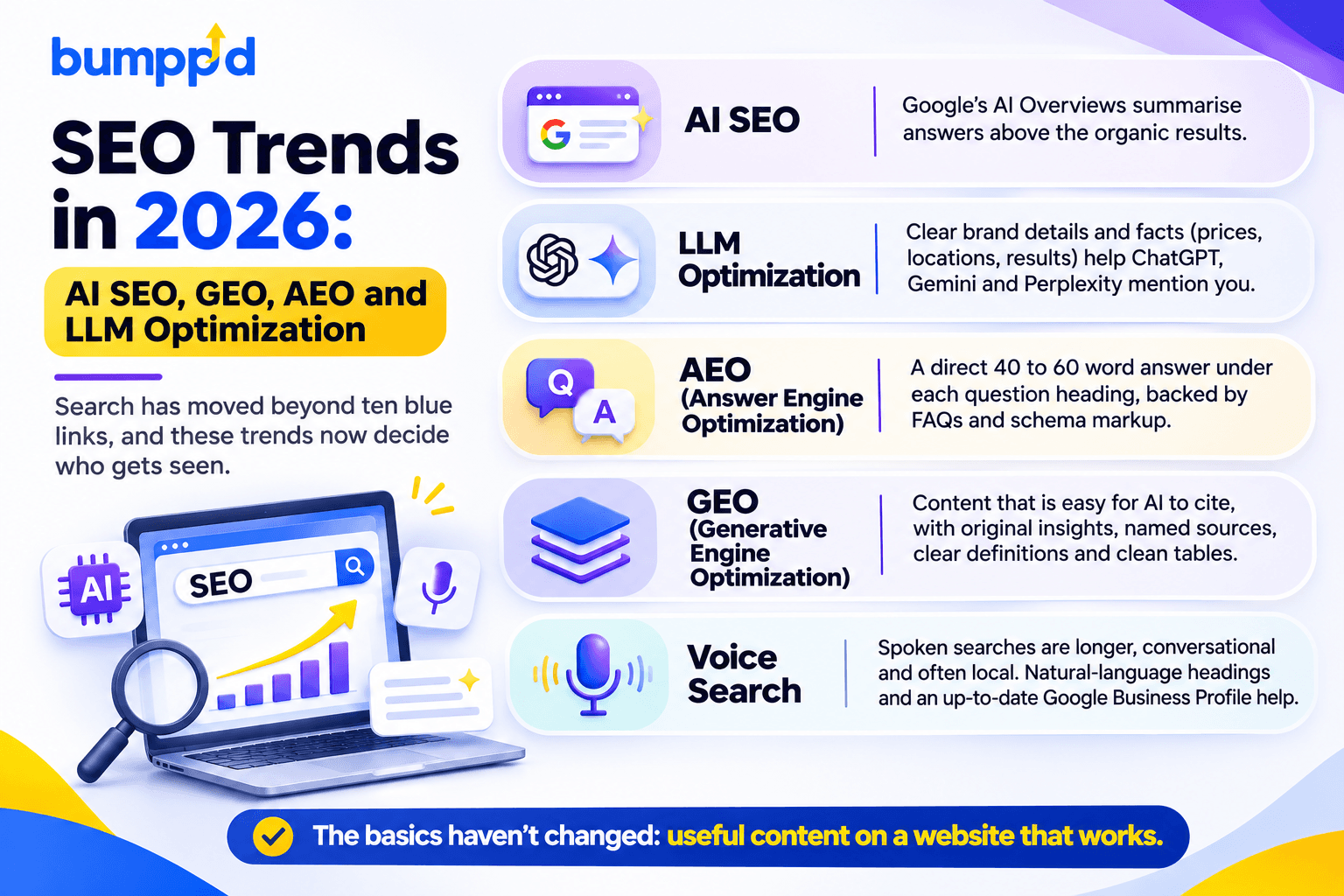
The biggest SEO trends in 2026 are AI SEO, LLM optimization, answer engine optimization (AEO), generative engine optimization (GEO) and voice search. Search has moved beyond ten blue links, and these trends now decide who gets seen.
AI SEO. Google's AI Overviews summarise answers above the organic results. Well-structured, trustworthy pages are the ones those summaries draw from.
LLM optimization. Consistent brand details and clear facts such as prices, locations and results help ChatGPT, Gemini and Perplexity mention you when people ask what to buy.
AEO (answer engine optimization). A direct 40 to 60 word answer under each question heading, backed by FAQs and schema markup.
GEO (generative engine optimization). Content that is easy for AI to cite, with original insights, named sources, clear definitions and clean tables.
Voice search. Spoken searches are longer, conversational and often local. Natural-language headings and an up-to-date Google Business Profile help.
The basics haven't changed: useful content on a website that works.
What Do Professional SEO Services Include?
Professional SEO services include five things: an SEO audit, on-page SEO, technical SEO, local SEO, and link building. Most full-service SEO packages cover all five.
SEO audit. A complete review of your site's technical setup, content, and backlinks. You should come away with a clear list of what to fix first.
On-page SEO. Titles, headings, and copy rewritten around what people actually search for.
Technical SEO. Faster pages, clean structure, proper schema, and no indexing errors, so Google can read every page.
Local SEO. An active Google Business Profile, matching listings everywhere, and a page for each area served.
Link building. Real backlinks from digital PR, guest articles, and content other sites want to cite. Nothing bought.
A good SEO provider explains all of this without jargon. You can see how Bumppd delivers each part on our SEO services page.
Conclusion: Is SEO Worth It?
Yes, SEO is worth it for any business whose customers search online, as long as you treat it as an ongoing process. It means understanding what your customers search for, fixing what holds your website back, and publishing content that answers their questions better than anyone else.
Every part of SEO, whether on-page, off-page, technical or local, works best when it follows a clear strategy built on keyword research, competitor analysis and regular audits.
If you would rather spend your time running your business, Bumppd can take it from here. As a digital marketing company in India, Bumppd provides SEO services that cover everything in this guide, from the first website audit to monthly reports on rankings, traffic and leads. [Request a free SEO audit] to see where your website stands today.
FAQs About SEO and SEO Services
What is SEO in simple words?
SEO is the work of making your website show up higher on Google when people search for what you offer. It stands for search engine optimization, and it brings visitors without paying for each click.
What are the 4 main types of SEO?
The four main types of SEO are on-page SEO, off-page SEO, technical SEO and local SEO. Online stores also use ecommerce SEO, and brands selling in several countries use international SEO.
Is SEO free?
Ranking in organic search is free in the sense that you don't pay Google per click. Doing SEO still costs time or money, whether you pay an SEO company, hire in-house or do the work yourself.
Which type of SEO service should a small business start with?
If most of your customers live nearby, start with local SEO. Fill out every field in your Google Business Profile, add real photos and ask happy customers for reviews. A plumber or a dental clinic will often get more calls from that alone than from months of blogging.
Are SEO services worth it on a small budget?
They can be, as long as you don't try to rank for everything. Pick five or six keywords people search right before they contact a business like yours, such as "emergency AC repair in Chandigarh". Build your best pages around those. Broader topics can wait.
Can I do SEO myself, or should I hire an SEO expert?
You can do basic SEO yourself. Writing useful pages and fixing title tags doesn't take a specialist. Site migrations, technical SEO errors, and link building are different: one wrong redirect during a redesign can wipe out years of rankings, and that is where an SEO expert pays for themselves.
What should a monthly SEO report include?
A monthly SEO report should show how your target keywords moved, how much traffic came from organic search, and how many leads or sales that traffic brought in. It should also list what was done last month and what is planned next.
How can I tell SEO is working before rankings improve?
Check impressions in Google Search Console. If more people are seeing your pages in search results, even before they click, you are moving in the right direction. Keywords climbing from page three to page two are another good early sign.
What happens if I stop paying for SEO services?
Nothing dramatic at first. Over the next few months, competitors publish fresher content, your older pages start to look dated and a few backlinks disappear. Rankings slide slowly, and winning them back usually costs more than holding on to them would have.
Do I need SEO if I already run Google Ads?
Yes, if you want leads that don't depend on ad spend. Ads stop the moment the budget runs out. SEO keeps bringing in visitors, and good organic rankings can lower how much you need to spend on ads over time.
Leave a comment