

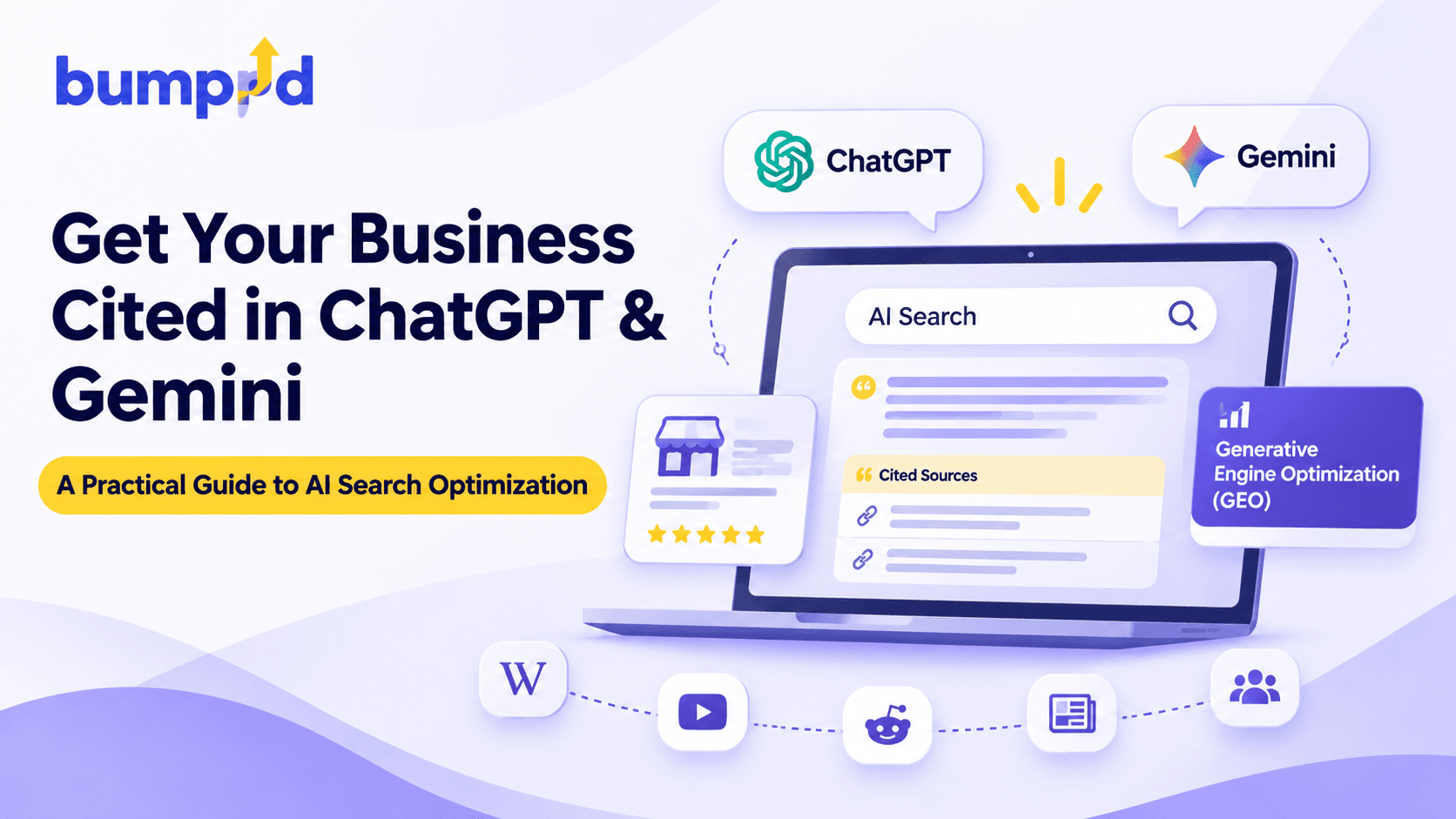
People now ask ChatGPT and Gemini to help them research products, compare services, and find businesses. Rather than a list of links, they get a direct answer, a side-by-side comparison, or a recommended brand, put together from information across the web. This is why AI search optimization is becoming important.
For businesses, this opens another route to customers, one that doesn't depend on where you rank on a results page. It also affects website traffic. A Pew Research Center study found that on visits where Google showed an AI summary, users clicked a traditional search result only 8% of the time.
In this guide, we explain how ChatGPT and Gemini choose the information they present, what influences the businesses they recommend, and how you can become more visible in AI-powered search.
What Is AI Search Optimization?
AI search optimization, also known as Generative Engine Optimization (GEO), is the work of preparing your content and online presence so AI assistants can find it, rely on it, and cite it in their answers. GEO was first named in a 2023 paper by researchers at Princeton, IIT Delhi, and other institutions.
The authors tried adding statistics, quotations, and source citations to web pages, and the strongest of these edits made a page show up in AI-generated answers up to 40% more often. Traditional SEO still matters because AI tools draw on pages that search engines can already find. What changes is the goal:
How ChatGPT and Gemini Choose Sources for AI Search Optimization
Neither company publishes a full ranking formula, but both explain the basics in their official documentation.
ChatGPT
ChatGPT uses OAI-SearchBot to find pages for its search answers. According to OpenAI's crawler documentation:
OAI-SearchBot: Allow it to crawl your site to appear in ChatGPT search answers.
GPTBot: This crawler gathers content to train OpenAI's models. Blocking it keeps your pages out of training data, but it won't remove you from ChatGPT search as long as OAI-SearchBot is still allowed.
Robots.txt updates: After you change your robots.txt file, give it about 24 hours before you check whether ChatGPT search reflects the update.
Gemini and Google AI Features
Google's guidance on AI features asks for less than most people expect:
Indexing: Your page has to be indexed and eligible to appear with a snippet in regular search results. If it can't show up there, it won't show up in AI Overviews or AI Mode either.
Text content: Put key details such as prices, services, and hours in plain text. Information that appears only inside an image is harder for Google to read.
Technical setup: You don't need an AI text file or special schema markup. Google states that no extra steps are required.
Business Profile: Keep your Google Business Profile current, especially your hours, address, and list of services.
If your site already follows Google's basic SEO advice, you've covered most of what Gemini SEO requires.
ChatGPT and Gemini Both Draw on Trusted External Sources
The Pew study found that Wikipedia, YouTube, and Reddit were among the sources Google's AI summaries cited most often. You may never have a Wikipedia page, but you can build a presence in the places these tools already read:
Industry websites: Get quoted or featured in trade publications and association sites that cover your field.
Online communities: Answer questions in Reddit threads and forums where your customers ask for advice, without turning every reply into a sales pitch.
YouTube: Film brief videos that respond to the questions customers bring you most often, and give each video that exact question as its title.
Business listings: Look through each directory and review site, check that your name, address, and phone number agree with your website, and correct any entry that doesn't.
How to Get Cited by ChatGPT and Gemini
For ChatGPT and Gemini to cite you, they need to be able to open your pages, understand what's on them, and find your business described correctly on other sites. The steps below take these in turn.
1. Let AI Crawlers In
Check your robots.txt file and make sure OAI-SearchBot and Googlebot aren't blocked. Then ask your hosting provider or CDN whether a firewall rule is quietly turning bots away. This one check is the foundation of ChatGPT SEO, so confirm it before you change anything else.
2. Answer the Question in the First Two Sentences
AI answers usually quote a sentence or two from a page rather than summarizing all of it. Write headings that match how people actually ask, such as "How much does a roof inspection cost in Dallas?", and answer directly in the opening lines underneath. Add the details afterward.
3. Give AI Facts It Can Quote
A line like "we offer great value" gives an AI tool nothing to repeat. Specific details include prices, timelines, years in business, service areas, and figures from your own work. If you run surveys or track customer outcomes, publish the findings. Original data is hard for anyone else to copy.
4. Keep Your Business Details Consistent
Check that your name, address, services, hours, and prices match everywhere they appear: your website, your Google Business Profile, Yelp, and every industry directory. If one listing still shows hours from two years ago, an AI tool may pass those hours on to a customer, who then turns up to a closed door.
5. Earn Mentions on Sites AI Already Trusts
Go where your customers already ask for advice. In practice, that could mean replying to questions in an industry Reddit thread, offering your expertise to a local news reporter, or publishing short YouTube videos that solve common problems. Every real mention is one more signal that leads AI tools to name your business.
6. Add Structured Data and Keep It Accurate
Schema markup for your organization, products, FAQs, and reviews tells search engines what each page is about and what it contains. Google's one firm rule is that structured data must match the visible text on the page.
7. Keep Key Pages Current
Old prices and outdated statistics can end up being repeated in AI answers, which confuses customers and costs you trust. Review your most important service and FAQ pages every quarter, and follow Google's advice to keep important content in text form rather than inside images.
How to Measure Your AI Search Optimization Results
AI search visibility is harder to track than rankings, but three sources give you a workable picture:
Search Console: Google counts traffic from AI Overviews and AI Mode in the Performance report under the "Web" search type. It isn't separated out, so watch for changes in impressions and clicks on question-style queries.
Analytics referrals: Look for visits from chatgpt.com and gemini.google.com. The numbers may be small, but these visitors often arrive already knowing what you offer.
Monthly prompt tests: Write 20 to 30 questions your customers really ask and run them in ChatGPT and Gemini each month. Record whether you are mentioned, which competitors appear, and whether the details about your business are correct.
Common AI Search Optimization Mistakes to Avoid
Some practices can limit your chances of appearing in AI-generated answers, even when your website has useful content. Avoid these common mistakes to keep your AI search optimization efforts on track.
Blocking the wrong crawler
Some sites block every OpenAI bot to stop model training and end up being removed from ChatGPT search too. Block GPTBot if you want, but leave OAI-SearchBot open.
Chasing shortcuts
Google states that AI features don't need special AI text files or new markup. That time is better spent rewriting your key pages so they answer customer questions clearly.
Stuffing keywords
Repeating the same phrase throughout a page makes it awkward to read and adds no new fact for an AI tool to quote.
Faking reviews or credentials
Fake reviews break the FTC rule mentioned above, and invented claims are easily contradicted by other sources.
Building Lasting Results With AI Search Optimization
Many searches now come with an AI-written answer, and few people click past it. AI search optimization helps make sure your business is part of that answer. The groundwork is familiar: let the right crawlers into your site, put prices and key answers in plain text, keep your business details identical across every listing, and earn genuine reviews and mentions. Each of these steps also supports your regular Google rankings.
Start by testing where you stand. Ask ChatGPT and Gemini the questions your customers ask, note which businesses get named, and check whether the details about you are correct. Tracking your AI search visibility this way each month shows what's working and what isn't. If you want an outside view, a focused audit can point you to the fixes that matter most.
FAQs
1. What is AI search optimization?
AI search optimization is the practice of shaping your website and online reputation so that AI assistants mention your business in their answers. Traditional SEO aims for a high spot in a list of links. AI search optimization aims for a place inside the answer itself, which is often the only part a searcher reads. It's also known as Generative Engine Optimization (GEO).
2. What makes ChatGPT SEO different from regular SEO?
Regular SEO focuses on Google, which finds pages through its own crawler, Googlebot. ChatGPT search uses a separate crawler called OAI-SearchBot. A page can rank first on Google and still never appear in ChatGPT if your robots.txt file blocks OAI-SearchBot, so check that setting before anything else.
3. Does Gemini SEO need a special schema or an AI text file?
No. Google says AI Overviews and AI Mode have no requirements beyond regular search: the page must be indexed and eligible to show a snippet. Structured data can still help Google understand your pages, as long as it matches the visible text.
4. How long does it take to get cited by ChatGPT?
After you allow OAI-SearchBot, OpenAI says the change can show up in search results in about 24 hours. Being cited regularly has no fixed timeline. The result depends on how directly your pages answer people's questions and how often other reputable sites mention your business.
Can a small business compete with large brands in AI answers?
Yes. AI tools look for the business that best matches the question, not the biggest name. If someone asks for a bakery in Austin that makes gluten-free birthday cakes, a local bakery whose website, Google Business Profile, and reviews say exactly that is a better match than a national chain. The more precisely your pages describe what you offer, where, and for whom, the better.

Leave a comment